

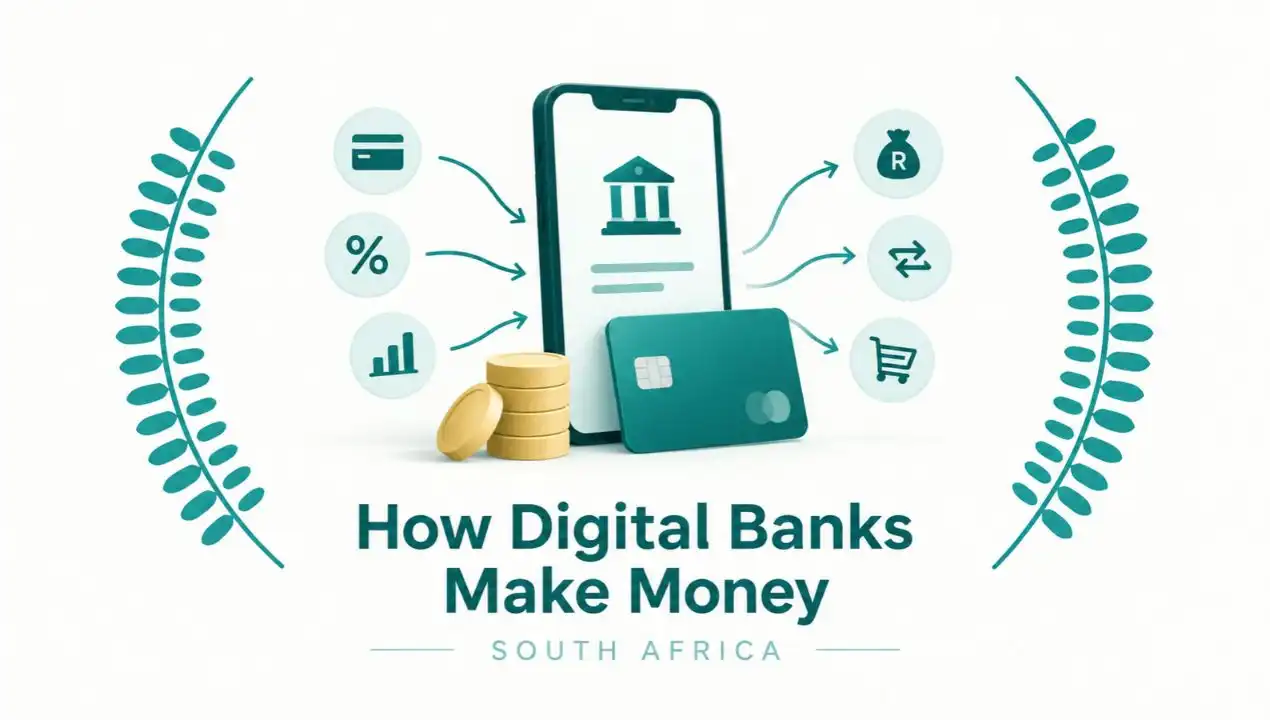
Digital banks make money in many of the same ways as traditional banks: interest on lending and investments, card-payment revenue, transaction fees, credit products and other financial services.
The main difference is their cost structure.
A digital bank can operate without a large branch network, use more automated processes and serve customers primarily through an app. That can make it possible to charge little or nothing for everyday banking while still building a profitable business.
South Africa already shows several versions of this model. GoTyme Bank, formerly TymeBank, focuses heavily on affordable digital banking and retail distribution. Bank Zero charges no monthly account fee and makes many ordinary digital transactions free. Discovery Bank combines digital banking with credit, payments, deposits and the wider Discovery ecosystem.
So when an account appears to be “free”, the bank is not necessarily providing banking for free. It may simply be making its money somewhere else.
What is a digital bank?
A digital bank provides most or all of its banking services electronically rather than relying on traditional branches.
Customers can typically use an app to:
- Open an account
- Make payments
- Transfer money
- Save
- Use a debit or credit card
- Manage security
- Apply for financial products
- View statements
- Contact support
Some digital banks are entirely branchless.
Bank Zero, for example, says it has no physical customer-facing branch network and designed its processes around digital interaction. Its explanation of the branchless model is available through the bank’s digital banking FAQs.
Other banks use digital technology alongside physical infrastructure or retail partnerships.
South Africa’s TymeBank officially became GoTyme Bank in February 2026, while retaining the same banking licence and underlying business. The bank described the change as part of its move toward a broader digital-first banking model in its official GoTyme Bank rebranding announcement.
Where does the money actually come from?
A digital bank can have several sources of revenue operating at the same time.
The major ones are:
- Net interest income
- Card-payment revenue
- Account and transaction fees
- Lending
- Foreign-exchange charges
- Value-added services
- Merchant and payment services
- Partnerships
- Investment income
Not every digital bank uses all of them equally.
A bank that offers substantial credit may depend heavily on interest income. Another may focus on payments, deposits and transaction revenue.
How do banks make money from your deposits?
Your deposit is both your money and an important source of funding for a bank.
Suppose customers collectively deposit R10 billion.
The bank does not simply keep all R10 billion sitting untouched in a vault. Subject to banking regulation, liquidity requirements and its own risk policies, deposits can help fund lending and other interest-earning assets.
The bank might:
- Pay customers interest on savings.
- Earn a higher return from loans or other qualifying assets.
- Keep part of the difference after funding costs, credit losses and operating expenses.
This difference contributes to net interest income.
What is net interest income?
Net interest income is broadly the difference between the interest a bank earns from interest-bearing assets and the interest it pays on funding such as deposits.
Imagine a simplified bank that:
- Pays depositors an average of 5%
- Earns an average of 10% on loans and other interest-earning assets
The difference is not automatically a 5% profit.
The bank still has to cover expenses including:
- Credit losses
- Technology
- Employees
- Regulatory costs
- Fraud losses
- Payment infrastructure
- Customer support
- Capital costs
- Taxes
But the spread between funding costs and asset yields is one of the foundations of commercial banking.
Can a digital bank make serious money from interest?
Yes. Discovery Bank provides a useful real example.
Discovery’s published banking results for the year ended June 2025 showed net interest income of R1.017 billion, up 30% from R780 million the previous year. The bank had R23.3 billion in retail deposits and R9.2 billion in advances at the end of that reporting period, according to Discovery’s 2025 integrated annual report.
This illustrates something important about digital banking.
An app may be the part the customer sees, but underneath it sits a balance-sheet business involving deposits, lending, funding, interest rates and credit risk.
What does a bank do with deposits it does not lend out?
Banks hold different types of assets rather than simply converting every rand of deposits into personal loans.
Depending on the institution and regulatory requirements, assets can include:
- Cash and central-bank balances
- Government securities
- Other investments
- Home loans
- Personal credit
- Business lending
- Credit-card balances
- Other advances
The bank must manage liquidity carefully so customers can access their money while the institution remains financially sound.
A digital bank cannot simply lend out every rand it receives.
It remains subject to banking regulation even if there are no branches.
How do digital banks make money when you pay by card?
Card payments can generate revenue for the bank that issued your card.
When you tap, swipe or use a card online, several organisations may be involved in processing the transaction.
These can include:
- The merchant
- The merchant’s acquiring bank or payment provider
- The card network
- Your issuing bank
Part of the economics of a card transaction can flow to the card-issuing bank through interchange.
That means a digital bank may benefit when customers actively use its cards even if it does not charge those customers a fee for every purchase.
What is interchange?
Interchange is part of the fee structure behind card payments.
Imagine that you use your digital bank card to spend R1,000 at a retailer.
You see a R1,000 purchase.
Behind the transaction, however, payment-system participants settle fees associated with processing and accepting that payment.
The card issuer can receive a portion of this payment economics.
One transaction may produce only a small amount of revenue. Millions of card transactions can become meaningful.
This is why digital banks often want to become your main transactional account, not an account that you open once and rarely use.
Why do banks want you to use their card so often?
An active customer is generally more valuable than an inactive one.
If you regularly use a bank for:
- Salary deposits
- Card payments
- Debit orders
- Savings
- Transfers
- Credit
- International purchases
The bank has more opportunities to earn revenue. It also gains a deeper picture of your financial behaviour, subject to privacy and financial-sector rules.
That can make it easier to offer additional products relevant to your financial circumstances.
The economics of digital banking are therefore strongly influenced by customer activity, not simply the number of accounts opened.
How can a bank offer free card purchases?
The customer does not necessarily need to be charged directly for the bank to make money from the transaction.
Bank Zero demonstrates this model clearly.
Its 2026 pricing structure currently charges R0 for ordinary in-store card transactions, online card transactions, EFTs and debit orders.
That does not mean every activity at the bank is free.
It charges for selected services such as cash withdrawals, certain immediate payments, card delivery, some foreign-currency activity and other optional or third-party-cost services.
A digital bank can therefore make core banking very cheap while earning elsewhere.
Do digital banks make money from monthly account fees?
Some do. Others deliberately do not.
A traditional bank might charge a fixed monthly account fee.
A digital bank may instead use:
- A lower monthly fee
- No monthly fee
- Pay-as-you-use pricing
- A subscription tier
- Fees on selected services
The pricing model is a business choice.
A zero-fee account does not mean the bank has no revenue model. It means monthly account fees are not the revenue source the bank has chosen to emphasise.
What other transaction fees can digital banks charge?
Depending on the bank, customers may pay for services such as:
- Immediate payments
- ATM withdrawals
- Cash deposits
- International transactions
- Foreign currency conversion
- Replacement cards
- Special payment services
- Certain cash-send services
Bank Zero’s 2026 pricing, for example, keeps its basic digital transactions free while charging R6.50 for certain immediate payments, higher charges in some circumstances, and fees for cash withdrawals and selected additional services through its current pricing guide.
Digital banking therefore does not necessarily eliminate fees. It can change which activities carry the fees.
Why is cash often more expensive?
Cash is expensive to handle.
Physical cash can require:
- ATMs
- Cash-in-transit services
- Retail partners
- Security
- Reconciliation
- Insurance
- Physical infrastructure
Digital payments can be cheaper to process at scale.
This creates a strong incentive for digital banks to encourage customers to use cards, EFTs and other electronic payments instead of cash.
Bank Zero’s current pricing explicitly describes cash as an area where customers pay while basic digital banking stays free.
How do digital banks make money from lending?
Credit can be one of a bank’s most valuable sources of revenue.
A digital bank could offer:
- Credit cards
- Personal loans
- Overdrafts
- Business credit
- Home loans
- Vehicle-related lending
The bank charges interest on the money borrowed.
If the interest earned exceeds its funding cost, operating costs and credit losses by enough, the lending portfolio can contribute to profit.
But lending also introduces one of banking’s biggest risks.
Some customers will not repay.
Why can’t a bank simply charge high interest and make more money?
Because a higher interest rate does not guarantee higher profit.
Suppose a bank lends R100 million and expects to earn substantial interest. If too many borrowers default, the bank can lose part of the original R100 million.
Banks therefore have to balance:
Revenue from lending
against
the risk that customers will not repay
This is exactly why credit analysts, credit scores, affordability assessments and risk models are so important.
A badly managed loan book can destroy the profits generated elsewhere in the bank.
What are credit losses?
Credit losses arise when borrowers fail to repay money as expected. Banks estimate expected losses and recognise provisions for credit risk.
Discovery Bank’s 2025 results reported a 3.03% credit loss ratio alongside its growing advances portfolio, as shown in Discovery’s integrated financial reporting.
This is why looking only at lending revenue gives an incomplete picture.
A bank can grow loans quickly and still have a poor business if the quality of those loans deteriorates.
How do digital banks decide who receives credit?
Technology allows banks to analyse large amounts of information quickly. Depending on the product and legal framework, the decision can incorporate:
- Income
- Existing debt
- Credit history
- Account behaviour
- Affordability
- Transaction patterns
- Internal risk models
- Credit-bureau data
For straightforward consumer credit, much of this can be automated.
The customer may receive a decision within minutes even though a substantial risk-assessment process is happening behind the app.
Do banks earn money from customers who never borrow?
Yes.
A customer can still create value through:
- Deposits
- Card transactions
- Paid services
- Foreign exchange
- Investment products
- Insurance or partner products
You therefore do not need to have a personal loan for your bank relationship to generate revenue.
A customer who keeps a substantial deposit balance and makes frequent card purchases may be commercially valuable without paying much in visible banking fees.
How do digital banks make money from foreign transactions?
Banks can charge fees or foreign-exchange margins when you spend or transfer money in another currency.
For example, Bank Zero’s 2026 pricing applies a 1.8% mark-up to card purchases in foreign currency, while local rand card transactions remain free under its published rates and pricing schedule.
Foreign-exchange revenue can become more valuable as customers travel, shop internationally or make cross-border payments.
Always compare the total currency-conversion cost rather than looking only for a separate transaction fee.
Do digital banks make money from savings accounts?
A savings account can contribute to the bank’s funding base.
The bank pays you interest, but deposits can support the wider balance sheet and interest-earning activities.
Digital banks therefore compete aggressively for deposits.
Higher savings rates can attract customers and funding, but those rates also increase the bank’s cost.
Management has to balance:
- Attracting deposits
- Paying competitive savings rates
- Finding profitable uses for the funding
- Maintaining liquidity
- Controlling risk
This is why deposit pricing can change when interest rates move.
Why would a bank pay you 6% interest?
Because your deposit has value to the bank.
Imagine Bank A can obtain funding from customers at an average cost of 6%.
If it can deploy that funding safely into assets earning sufficiently more than 6%, the deposit can contribute to the bank’s interest margin.
But that simple example leaves out regulatory capital, liquidity, operating expenses and losses.
A high savings rate is therefore not necessarily generosity. It can be part of the bank’s funding strategy.
Can a bank lose money even with billions in deposits?
Yes. Deposits are not profit.
They are generally liabilities of the bank because the money is owed back to customers.
A bank with R20 billion in deposits has not earned R20 billion. Its profitability depends on what it earns from its assets and services after subtracting:
- Interest paid to depositors
- Credit losses
- Operating expenses
- Technology costs
- Employee costs
- Regulatory costs
- Other expenses
This distinction is essential when reading stories about rapidly growing digital banks.
Customer deposits and revenue are completely different financial measures.
What is non-interest revenue?
Non-interest revenue is bank revenue that does not primarily come from the interest spread between assets and funding.
It can include areas such as:
- Banking fees
- Card and payment income
- Service revenue
- Commissions
- Other financial-service income
Discovery Bank reported R1.373 billion in non-interest revenue for FY2025, up 32% from R1.039 billion the previous year, according to Discovery’s 2025 integrated annual report.
Its net interest income over the same period was R1.017 billion.
That combination shows why modern banking should not be thought of as a business that earns money from just one source.
Can payment fees become a major revenue source?
They can, particularly when a bank has a large, active customer base.
A digital bank might earn only a small amount from an individual transaction.
But imagine:
- 5 million customers
- 40 card purchases per customer each month
- 200 million transactions
Even relatively small economics per transaction can become commercially significant at that scale.
This is one reason scale is so important to digital banking.
Technology can allow the cost of serving each additional active customer to grow more slowly than revenue.
Why do digital banks care so much about customer numbers?
Customer growth creates the possibility of greater:
- Deposits
- Card activity
- Credit demand
- Transaction volumes
- Cross-selling
- Fee income
But customer numbers alone are not enough. A bank could attract millions of people who barely use their accounts.
Those accounts still create technology, compliance and support costs.
The more useful measure is often active and engaged customers.
Discovery Bank, for example, reported more than 1.24 million clients and nearly 3 million accounts at the end of FY2025 alongside growth in deposits, advances and revenue in its published banking results.
Why can digital banks charge lower fees?
One of their biggest potential advantages is a lower operating-cost structure.
Traditional banking infrastructure can involve:
- Hundreds of branches
- Large ATM networks
- Branch employees
- Physical security
- Cash handling
- Property leases
- Branch equipment
A digital-first institution can eliminate or reduce some of those costs.
Bank Zero explains that its model was built without a conventional customer-facing branch network and attributes part of its low-cost structure to its technology and mutual-bank structure in its explanation of its operating model.
Saving money on branches does not eliminate costs entirely, however.
What does a digital bank still have to pay for?
Running a serious banking operation is expensive even without branches.
Costs can include:
- Software development
- Cloud and computing infrastructure
- Cybersecurity
- Fraud prevention
- Compliance
- Banking licences
- Regulatory reporting
- Payment systems
- Card networks
- Customer support
- Marketing
- Data systems
- Credit models
- Employees
- Deposit insurance costs
A digital bank still has to protect customer money, process payments reliably and comply with financial regulation.
The absence of branches is a cost advantage, not an escape from banking infrastructure.
Are digital banks real banks?
A digital bank can be a fully regulated bank. The important issue is its licence, not whether it has branches.
South Africa includes conventional commercial banks, mutual banks and other regulated deposit-taking institutions.
Bank Zero, for example, operates as Bank Zero Mutual Bank, while GoTyme Bank continues operating under the banking licence previously used under the TymeBank name. GoTyme confirmed that licence continuity when it announced its 2026 brand transition.
Being digital therefore describes how banking is delivered, not whether the institution is regulated.
Do digital banks benefit from customer data?
Transaction data can help a bank understand how customers use financial services.
Subject to applicable privacy, banking and consumer-protection rules, data analysis can help banks with:
- Fraud detection
- Credit-risk assessment
- Personalised offers
- Customer support
- Financial management tools
- Product development
A bank might identify that a customer consistently receives a salary, maintains a stable balance and pays obligations on time.
That information can potentially improve risk assessment compared with relying only on a once-off application form.
But data is not free money.
Banks still need lawful grounds and appropriate controls for how customer information is collected, processed and protected.
Do digital banks sell customer data to make money?
That is not the core banking model you should assume when analysing a regulated digital bank.
The central economics of banking are much more directly connected to deposits, lending, payments, financial products and services.
Data can improve those activities, but saying a bank makes its money simply by “selling your data” misses how a banking balance sheet works.
Privacy policies and applicable law should be checked if you want to know how a particular institution handles personal information.
What is cross-selling?
Cross-selling means offering an existing customer additional products. A person may start with a free transactional account and later take:
- A savings account
- Credit
- Insurance
- An investment
- Another payment service
The original free account can therefore act as an entry point into a broader financial relationship.
This strategy can be particularly powerful for digital banks because the app gives them a direct channel to existing customers without needing a branch visit.
Why might a bank give you rewards?
Rewards can encourage behaviour that is commercially useful to the bank or its partners.
These behaviours could include:
- Using the bank’s card
- Saving
- Shopping with partners
- Using other products
- Maintaining engagement
Rewards have a cost, so the bank needs to earn enough elsewhere to justify them.
A R50 reward is not necessarily a R50 loss if the behaviour it generates produces greater long-term value for the bank.
Can partnerships make money for digital banks?
Yes. Banks can partner with:
- Retailers
- Insurers
- Investment providers
- Payment companies
- Telecom businesses
- Merchants
The exact commercial arrangement differs.
A bank might earn commissions, service revenue or other income where permitted, while the partner gains access to banking customers or infrastructure.
Partnerships can also reduce costs.
A digital bank does not necessarily need to build every service itself if an established external network already exists.
Why do some digital banks use supermarkets and retailers?
Retail networks can solve a major problem: cash.
A digital bank may not want to build thousands of branches and ATMs, but customers can still need to deposit or withdraw physical money.
Retail partnerships can provide cash access without the bank owning the entire network.
Bank Zero’s current model, for example, supports selected cash transactions through major retailers while charging separately for some of those cash services under its 2026 banking pricing.
The bank stays digital while using existing physical infrastructure when necessary.
Why are digital banks often obsessed with scale?
Digital banking has significant fixed costs. A bank might spend heavily building:
- Its app
- Core banking systems
- Security infrastructure
- Compliance systems
- Data platforms
- Customer-service operations
Once those systems exist, adding another customer may cost much less than building another physical branch.
That creates the possibility of operating leverage.
If revenue grows faster than operating costs as the customer base expands, profitability can improve sharply.
But the opposite can also happen. A bank that spends heavily acquiring customers without generating enough revenue can continue losing money despite impressive growth.
Why can a digital bank lose money for years?
Building a bank requires substantial upfront investment.
A new institution may initially spend heavily on:
- Technology
- Employees
- Marketing
- Compliance
- Customer acquisition
- Product development
while its deposit base, credit book and payment volumes are still small.
That can produce years of losses before revenue catches up.
Discovery Bank provides a useful example of this progression. Its FY2025 normalised operating loss fell to R68 million from R454 million a year earlier while total revenue rose 31% to R2.39 billion, according to Discovery’s integrated results.
Rapid growth and profitability are therefore separate questions.
Is a bank with no monthly fee sustainable?
It can be.
Whether the model works depends on the complete economics of the customer relationship.
Suppose a bank charges you R0 per month but earns revenue from:
- Card activity
- Deposits
- Lending
- Foreign exchange
- Selected service charges
If that revenue exceeds the cost of serving you and the capital required to support the business, the account can be economically sustainable.
The monthly fee is only one line in the equation.
Why don’t all banks simply make everything free?
Different banks have different:
- Customer bases
- Cost structures
- branch networks
- Product ranges
- Technology systems
- Capital requirements
- Revenue strategies
A large bank with extensive branches and ATMs has a different cost base from an app-focused institution.
Traditional banks can also generate substantial revenue from corporate banking, investment banking, mortgages, wealth management and other activities that some smaller digital banks do not offer.
There is therefore no single perfect banking model.
Does cheaper banking mean lower savings rates?
Not necessarily.
Transaction pricing and savings pricing solve different business problems.
A bank might simultaneously:
- Charge no monthly account fee
- Offer competitive savings interest
- Charge for selected services
- Earn money from other parts of the relationship
Bank Zero, for example, currently combines zero monthly transactional-account fees with tiered savings and notice-deposit rates published in its 2026 rates schedule.
You therefore need to compare each part of the banking offer rather than assuming a cheap transactional account means poor savings value.
Does a digital bank need loans to survive?
Not necessarily, although lending can create a major revenue stream. Different banking models can place different weight on:
- Lending
- Deposits
- Payments
- Fees
- Investments
- Partnerships
Bank Zero, for example, explains that its mutual-bank structure and narrower service model allow it to operate differently from traditional banks in its banking model FAQs. (Bank Zero)
A digital bank therefore does not need to copy the product mix of South Africa’s largest universal banks.
What happens when interest rates fall?
Changing interest rates can affect both sides of a bank’s balance sheet.
The bank may earn less on some loans and investments, while the interest it pays depositors may also fall.
The impact on profitability depends on:
- How quickly loan rates change
- How quickly deposit rates change
- The type of lending
- Fixed versus variable rates
- Deposit mix
- Customer behaviour
This is why bank profitability can move when the South African Reserve Bank changes monetary policy, even when customer numbers barely change.
What is the biggest financial risk for a digital bank?
There is no single risk, but several can become serious:
- Customers defaulting on credit
- Depositors withdrawing funds quickly
- Fraud
- Cyberattacks
- Technology outages
- Weak customer growth
- Excessive acquisition costs
- Poor interest-rate management
- Regulatory failures
Being digital removes certain physical costs but introduces heavy dependence on technology.
A branch outage may affect one area.
A major app or core-banking outage can affect the entire digital customer base at once.
Is a digital bank automatically cheaper than a traditional bank?
No. Digital architecture can support lower costs, but the actual customer price depends on the bank’s strategy.
A digital bank could charge for services that another bank bundles into a monthly package.
The right comparison is therefore your total expected banking cost.
Look at:
- Monthly fee
- EFTs
- Immediate payments
- Cash withdrawals
- Cash deposits
- Card fees
- International spending
- Foreign-exchange margins
- Debit orders
A R0 monthly fee can still become expensive if the services you use most carry high individual charges.
What should you compare when choosing a digital bank?
Start with how you actually use money.
If you rarely touch cash, a bank with free digital payments but expensive ATM withdrawals may still be excellent value.
If you deposit cash every week, the calculation changes.
Also compare:
- Savings interest
- App reliability
- Security
- Card controls
- Customer support
- Cash access
- Immediate-payment costs
- International fees
- Credit products
- Deposit protection
A bank’s business model matters because it often tells you where the costs have been moved.
How do digital banks make money if banking is free?
The simplest answer is that your monthly account fee was never the only way a bank could make money.
Digital banks can earn revenue from:
| Revenue source | How it works |
|---|---|
| Net interest income | Earn more on loans and assets than the cost of funding |
| Card payments | Earn part of the economics associated with card transactions |
| Credit | Charge interest and applicable fees on lending |
| Transaction charges | Charge for selected payments, cash or premium services |
| Foreign exchange | Earn fees or margins on international transactions |
| Deposits and investments | Use deposits as part of the bank’s funding and asset strategy |
| Partnerships | Generate revenue from qualifying partner products and services |
| Additional products | Sell credit, savings, investment or other financial products |
A digital bank’s competitive advantage is often not that it has discovered a completely new way of making money.
It has found a cheaper way to deliver banking.
Without hundreds of branches and much of the physical infrastructure associated with traditional banking, it can choose to give customers free or low-cost everyday transactions while earning revenue through interest, payments, credit and other services.
That is why a digital bank can charge you R0 per month and still want you as a customer.
The value may come from your deposits, card activity, borrowing, international spending or the broader financial relationship you build with the bank.
