

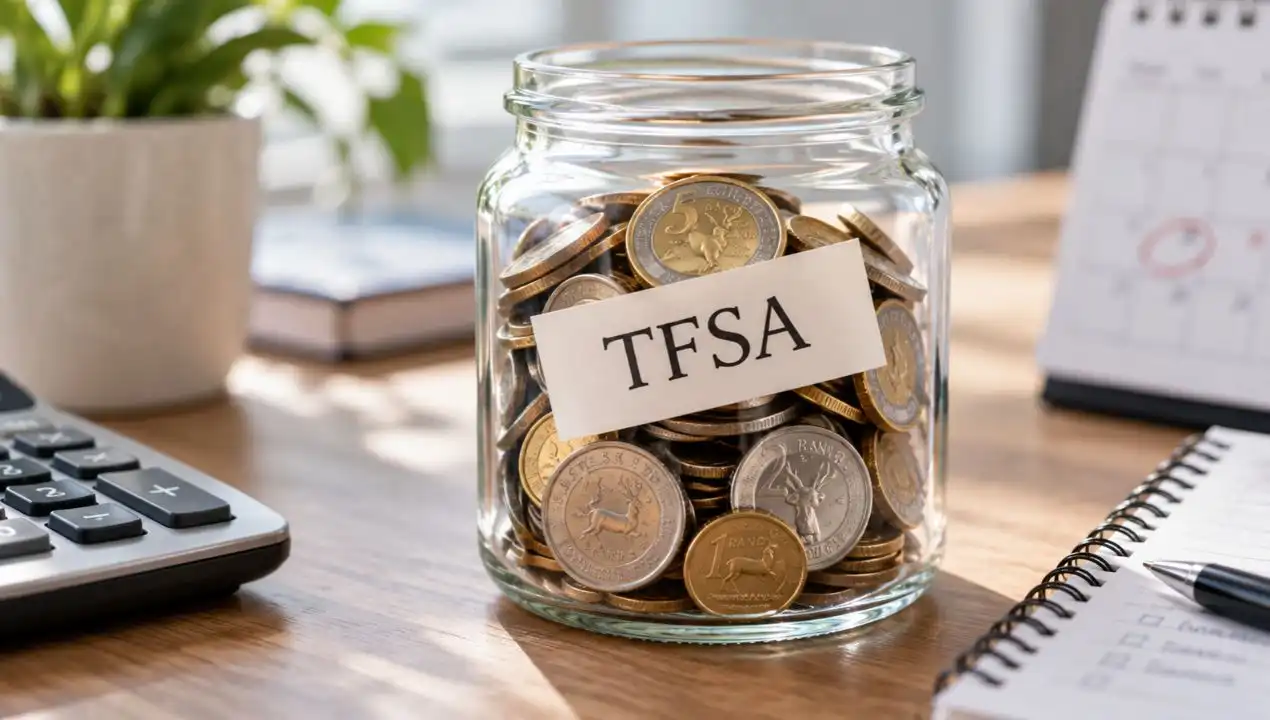
South Africans can contribute up to R46,000 to Tax-Free Savings Accounts during the 2027 tax year, which runs from 1 March 2026 to 28 February 2027. The lifetime contribution limit remains R500,000 per person.
The annual limit increased from R36,000 to R46,000 on 1 March 2026. SARS confirms the new amount in its Tax Free Investments guidance, while its 2026 Budget FAQs confirm that the R500,000 lifetime ceiling has not changed.
The most important detail is that these are contribution limits, not limits on how large your investment is allowed to become. If R500,000 of contributions eventually grows to R800,000, R1 million or more, that investment growth does not breach the TFSA limit.
Problems arise when you contribute too much, withdraw money and later replace it, or forget that the annual allowance applies across all of your TFSAs combined.
What is the TFSA limit for 2026?
The current annual contribution limit is R46,000 for the tax year from 1 March 2026 to 28 February 2027.
South Africa calls this the 2027 year of assessment, even though most of the period falls within calendar year 2026.
According to the SARS Tax Free Investments rules, the annual allowance was R36,000 for the 2021 to 2026 years of assessment and increased to R46,000 from the 2027 year of assessment.
That gives you R10,000 more annual contribution room than under the previous limit.
How much can you contribute per month?
If you want to spread the R46,000 allowance evenly across 12 months, it works out to approximately:
R3,833.33 per month
You do not have to contribute monthly.
You could invest the full R46,000 at once, make irregular deposits during the year or use a monthly debit order. What matters is the total amount contributed during the tax year.
For example, you could contribute R20,000 in April and another R26,000 in December and still remain within the annual allowance.
What is the lifetime TFSA limit?
The lifetime contribution limit is R500,000 per person.
Unlike the annual allowance, the lifetime amount does not reset each year.
If you have already contributed R300,000 over previous years, you have R200,000 of lifetime contribution room left, even if the investments themselves are now worth much more.
SARS applies the annual R46,000 allowance and the R500,000 lifetime ceiling at the same time.
Does investment growth count toward the R500,000 limit?
No. Investment growth does not use additional contribution room.
Suppose you have contributed R400,000 over several years and your portfolio has grown to R650,000.
For TFSA-limit purposes, your contributions are still:
R400,000
You therefore still have:
R100,000 of lifetime contribution room
SARS specifically states that returns capitalised inside a TFSA do not count toward either the annual or lifetime contribution limits.
This distinction is one of the strongest features of the TFSA structure because there is no contribution-limit penalty simply because successful investments grow beyond R500,000.
What taxes do you avoid inside a TFSA?
Returns generated inside an approved tax-free investment are exempt from:
- Income tax
- Dividends tax
- Capital gains tax
SARS confirms all three exemptions in its Tax Free Investments overview.
That can become increasingly valuable over a long investment period.
Outside a TFSA, South African dividends are generally subject to 20% dividends tax, while capital gains can become taxable after the relevant exclusions and other rules are applied. The SARS 2026 Tax Guide confirms the general 20% dividends-tax rate.
For the 2027 year of assessment, the annual capital-gains exclusion for individuals is R50,000.
Inside a qualifying TFSA, you do not need those ordinary exemptions to shelter investment returns generated within the account.
Does the R46,000 limit apply to each TFSA?
No. The R46,000 allowance applies to you as a taxpayer across all your TFSAs combined.
Suppose you contribute:
- R20,000 to a TFSA at one provider
- R26,000 to another TFSA
Your total contribution is R46,000.
You have used your full allowance.
If you then put another R5,000 into a third TFSA, your total annual contribution becomes R51,000 and you have exceeded the limit by R5,000.
SARS specifically states that the annual allowance is aggregated across all tax-free investments held by the same person.
What happens if you contribute more than R46,000?
Excess contributions attract a 40% penalty tax.
Suppose you contribute R50,000 during the current tax year.
The calculation is:
R50,000 – R46,000 = R4,000 excess
The penalty is:
R4,000 × 40% = R1,600
SARS uses this same example in its current TFSA guidance and explains that the penalty becomes part of the normal tax payable on assessment.
That makes exceeding the contribution limit particularly expensive.
What happens if you exceed the R500,000 lifetime limit?
The 40% excess-contribution penalty also applies when you exceed the lifetime ceiling.
Suppose your cumulative lifetime contributions have reached R495,000 and you contribute another R20,000.
You only had:
R5,000 of lifetime room remaining
Your excess contribution is therefore:
R15,000
The potential penalty is:
R15,000 × 40% = R6,000
Keeping your own contribution history becomes increasingly important as you approach the R500,000 lifetime maximum.
Can unused TFSA allowance roll over?
No. Any part of the annual allowance that you do not use is lost when that tax year ends.
If you contribute only R20,000 during a year with a R46,000 allowance, the unused R26,000 cannot be added to the next year’s allowance.
SARS expressly states that unused annual contribution room is forfeited and does not carry forward.
The following tax year simply starts with whatever annual limit applies at that time.
Do withdrawals restore your contribution room?
No. This is one of the most important TFSA rules.
Suppose you contribute the full R46,000 and then withdraw R20,000.
You have still used R46,000 of annual contribution room.
If you later put that R20,000 back into a TFSA during the same year, it is treated as a new contribution.
Your contribution total becomes:
R46,000 + R20,000 = R66,000
You would therefore have exceeded the annual limit by R20,000.
At a 40% penalty rate, that could create:
R8,000 in additional tax
SARS specifically distinguishes investment returns that remain inside the TFSA from money withdrawn and subsequently reinvested. The latter counts as a new contribution.
Does withdrawing money reduce your lifetime contributions?
No. Suppose you have contributed R200,000 over several years and later withdraw R100,000.
You have still used R200,000 of your R500,000 lifetime allowance.
If you eventually reinvest the R100,000, that deposit counts again.
Your lifetime contribution total would then move to R300,000.
This is why frequently moving money in and out of a TFSA can permanently consume valuable lifetime contribution room.
Can you transfer a TFSA without losing contribution room?
Yes, if you use a proper provider-to-provider transfer.
SARS confirms that transfers between qualifying tax-free investments have been permitted since 1 March 2018.
That is different from personally withdrawing the money and depositing it elsewhere.
If you want to move your TFSA to another provider, arrange a formal transfer between the providers rather than paying the money into your normal bank account first.
A properly structured transfer does not create a fresh contribution simply because the provider changed.
Can you have more than one TFSA?
Yes. You could, for example, have:
- A tax-free fixed deposit at a bank
- A TFSA holding ETFs through an investment platform
The number of accounts is not the problem.
The important figure is your combined annual contributions across all of them.
Multiple TFSAs can therefore create a record-keeping challenge if you are contributing to several accounts at once.
What investments can you hold in a TFSA?
A TFSA is a tax structure, not one specific investment product.
The SARS list of qualifying tax-free investment types includes examples such as:
- Fixed deposits
- Unit trusts
- Certain long-term insurance products
- Linked investment products
- Qualifying exchange-traded funds
The investments you choose determine the risk and potential return.
Two people can both have TFSAs while having completely different investment experiences because one holds cash and the other owns equity ETFs.
Is a TFSA just a savings account?
No. The term Tax-Free Savings Account can create the impression that the account must contain bank savings.
It can also be used for qualifying investments.
For example, one TFSA might contain a fixed deposit paying interest.
Another might contain diversified ETFs.
Both can receive the same tax treatment, but their expected volatility and long-term return characteristics can be very different.
That distinction is important when deciding how to use scarce lifetime TFSA contribution room.
Can you invest in ETFs through a TFSA?
Yes, qualifying ETFs can be held within approved TFSA structures.
That means eligible dividends, capital growth and other qualifying returns can accumulate inside the tax-free environment without the ordinary income tax, dividends tax or capital gains tax that could otherwise apply.
For someone investing over several decades, that can make a TFSA particularly valuable for growth assets.
The tax advantage does not remove investment risk, however. An ETF can still rise or fall in value.
Can children have TFSAs?
Yes. A minor can have a TFSA.
The important point is that contributions made for the child use the child’s own annual and lifetime contribution limits.
SARS explicitly confirms that parents can invest on behalf of minor children and that the child uses their own allowance.
If you contribute R46,000 into your child’s TFSA this year, you have therefore used R46,000 of the child’s contribution history, not your own.
That deserves careful thought because the lifetime limit is finite.
How long does it take to reach the R500,000 lifetime limit?
The answer depends on when you started and how much you contribute.
SARS records the historical annual limits as:
| Tax years | Annual limit |
|---|---|
| 2016 to 2017 | R30,000 |
| 2018 to 2020 | R33,000 |
| 2021 to 2026 | R36,000 |
| 2027 | R46,000 |
A person who contributed the maximum every year from the introduction of TFSAs would have accumulated R375,000 of contributions by the end of the 2026 year of assessment.
Adding the full R46,000 for 2027 brings the cumulative contribution total to:
R421,000
SARS includes this historical progression in its TFSA guidance.
The annual limit may change again in future, so you should not assume R46,000 will remain permanent.
What happens once you reach the R500,000 limit?
You stop making new TFSA contributions.
You do not have to close or cash out the investment.
The existing portfolio can continue growing inside the tax-free structure.
If your R500,000 of lifetime contributions grows to R800,000, R1 million or more, the higher account value does not itself cause an excess-contribution penalty.
The restriction is on how much capital you add, not how successful the investments are afterward.
Should you contribute the full R46,000 every year?
Only if it fits your wider financial position.
The TFSA tax benefit is useful, but maximising the account should not force you to borrow expensive money or leave yourself without accessible emergency savings.
Someone who has:
- High-interest debt
- No emergency fund
- Unstable income
may have other priorities before using every rand of annual TFSA allowance.
The account becomes particularly powerful when the money can remain invested for a long period without repeated withdrawals.
Should you keep your emergency fund in a TFSA?
Usually, it is worth thinking carefully before doing so.
Emergency savings need to be accessible because you may actually need to withdraw them.
That creates a problem inside a TFSA.
If you contribute R40,000, withdraw it for an emergency and later replace it, both contributions can count toward your lifetime contribution history.
You may therefore consume R80,000 of lifetime room while only having R40,000 invested again.
An ordinary high-interest savings account can be more suitable for money you expect to move in and out, leaving the TFSA for long-term investments.
Is the limit based on deposits or the account balance?
The limit is based on contributions.
Suppose your account shows:
Lifetime contributions: R300,000
Current market value: R450,000
For lifetime-limit purposes, the important figure is R300,000.
The extra R150,000 represents investment growth and does not consume more contribution room.
This is why looking only at your current TFSA balance cannot tell you how much lifetime room you have left.
Do reinvested dividends count as new contributions?
Not when the returns remain inside the TFSA.
If an ETF pays a dividend into your TFSA and the money is reinvested without being withdrawn from the tax-free structure, it forms part of the investment return.
SARS states that capitalised investment returns do not count toward the annual or lifetime contribution ceilings.
The problem arises when you withdraw those returns and later contribute the money again yourself.
That later deposit becomes a new contribution.
Do TFSA providers report information to SARS?
Yes. SARS requires providers to report information including:
- Contributions
- Withdrawals
- Transfers
- Investment returns
Providers also issue an annual IT3(s) Tax Free Investment certificate containing relevant TFSA information.
Keep these certificates.
They become especially useful if you use several providers or are getting close to the lifetime contribution ceiling.
How should you track your lifetime contributions?
Maintain your own record rather than relying only on the current investment balance.
Track:
- Contributions by tax year
- Provider
- Formal transfers
- Withdrawals
- Cumulative lifetime contributions
Keep your IT3(s) certificates with those records.
A portfolio worth R600,000 might contain only R350,000 of actual contributions, while another worth R400,000 could contain nearly R400,000 of contributions.
The market value does not tell you how much lifetime allowance you have used.
What is the biggest TFSA mistake?
Repeatedly withdrawing and replacing money.
Because contribution room is not restored, you can use large portions of your lifetime allowance without keeping much money invested.
Imagine repeatedly cycling R50,000 through the account over several years.
You could consume hundreds of thousands of rand of lifetime contribution room while ending up with a relatively small TFSA balance.
That undermines one of the biggest advantages of the account: giving investments decades to compound free of tax.
What are the current TFSA rules for 2026?
For the 2027 year of assessment from 1 March 2026 to 28 February 2027, the rules to remember are:
- Annual contribution limit: R46,000
- Lifetime contribution limit: R500,000
- Excess-contribution penalty: 40%
- Unused annual allowance: does not carry forward
- Withdrawals: do not restore contribution room
- Investment growth: does not count as a contribution
- Formal provider-to-provider transfers: do not use new contribution room
- Multiple TFSAs: allowed, but the annual limit applies across all accounts combined
These rules are set out in the current SARS Tax Free Investments guidance.
The increase from R36,000 to R46,000 gives South Africans considerably more tax-free investment capacity each year.
The lifetime ceiling, however, is still R500,000.
That makes each rand of lifetime contribution room valuable. For long-term investors, the strongest use of a TFSA is generally not repeatedly moving cash in and out. It is giving suitable investments as much time as possible to grow inside the tax-free environment.
