
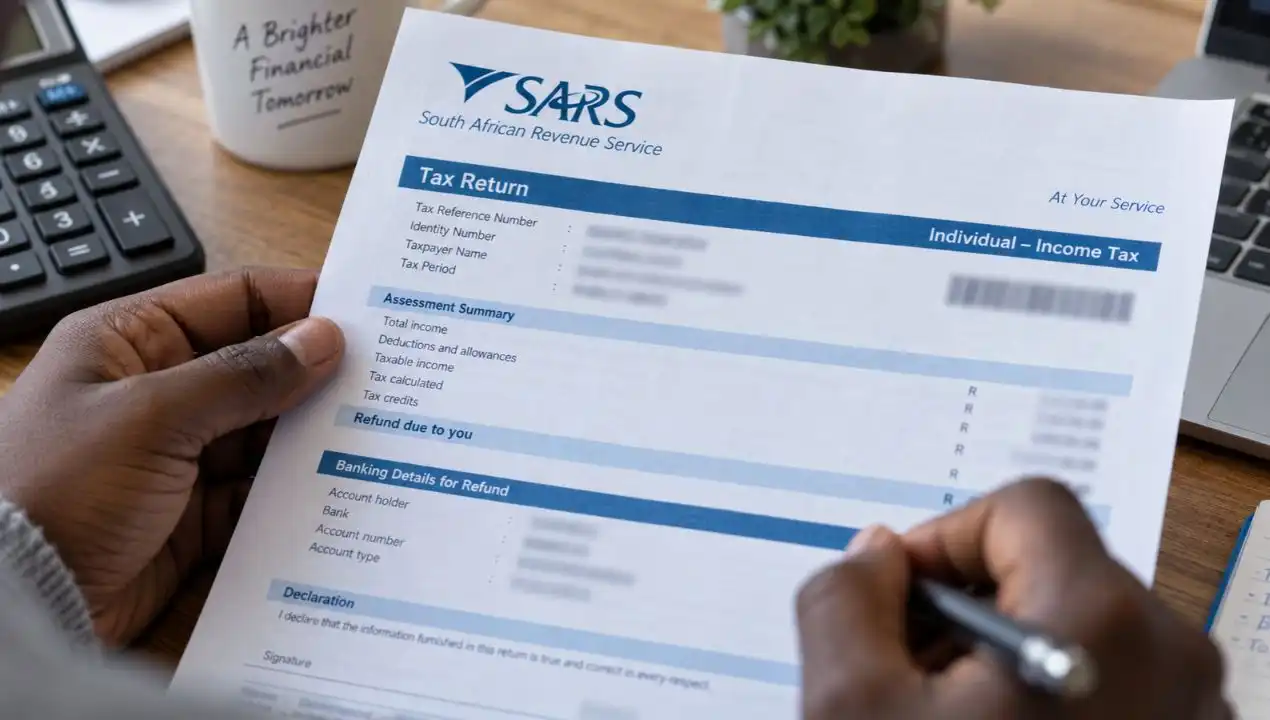
A SARS tax refund is money paid back to you when your final income-tax assessment shows that you paid more tax than you actually owed.
For most straightforward individual refunds of more than R100, SARS aims to pay the money within 72 hours after the assessment is completed, provided your banking details are correct, you have no outstanding returns or tax debt, and the return has not been selected for verification or audit.
SARS confirmed this again during the 2026 Filing Season, when it set out specific turnaround times for refunds, verifications and audits.
How do you know if SARS owes you a refund?
Your tax assessment will show whether money is due to you, owed by you, or whether the balance is zero.
On your ITA34 assessment, a negative amount generally means SARS owes you money.
SARS explains in its July 2026 Tax Digest that a negative amount on the assessment indicates a refund is due.
For example, if your assessment shows:
R-4,500
that generally means SARS has calculated that R4,500 should be refunded to you, subject to any checks or amounts that still need to be resolved.
Why would SARS owe you money?
A refund usually arises because more tax was paid during the year than your final assessment requires.
That can happen for several reasons.
You may have:
- Had too much PAYE deducted
- Qualified for retirement-fund deductions
- Qualified for medical tax credits
- Worked for only part of the tax year
- Changed employers
- Had deductible expenses
- Made provisional-tax payments that exceeded the final liability
- Had tax credits or other adjustments that reduced the final amount due
PAYE is collected during the year based on payroll information.
Your tax return then gives SARS the information needed to calculate the final liability.
If you paid too much, the difference can become a refund.
How long does a SARS refund take?
For an uncomplicated refund of more than R100, the normal target is within 72 hours after the assessment has been completed.
SARS states in its refund timing guidance that the 72-hour period starts once the assessment is complete, provided:
- The refund is more than R100
- Your banking details are correct
- You have no outstanding returns
- You have no tax debt that must first be resolved
- No verification, inspection or audit is required
During the opening of the 2026 Filing Season, SARS reported that it had already paid about R8 billion in refunds to more than 1.9 million auto-assessed taxpayers, with payments made within 72 hours. The figures were published in SARS’s 2 July 2026 Filing Season update.
Does 72 hours mean three business days?
SARS commonly refers to the refund target as 72 hours.
In practice, you should not assume that every refund will arrive exactly 72 clock-hours after filing your return.
The clock starts from the completed assessment, not necessarily from the moment you press Submit.
If SARS needs to verify your return or banking details first, the refund process can take significantly longer.
Does filing a tax return immediately start the refund process?
Not necessarily.
Submitting your return and receiving a completed assessment are related but separate steps.
SARS first processes the information and issues an assessment.
If no additional checks are required and a refund is due, payment can then proceed.
If the return is flagged for verification or audit, SARS may ask you for supporting documents before the refund is released.
That means filing on Monday does not automatically guarantee that the money will be in your bank account by Thursday.
What happens if SARS selects your return for verification?
Verification means SARS wants supporting evidence for information declared on your return.
If your ITA34 indicates that verification is required, you generally need to submit the requested documents.
According to SARS’s current 2026 refund and verification guidance, taxpayers are expected to provide requested supporting documents within 21 days.
After SARS receives all the required information, it may take up to 21 business days to finalise the verification.
If the verification is completed successfully and the refund is still due, payment can generally follow within the normal refund processing period.
What documents can SARS request during verification?
The documents depend on what you declared.
SARS might request evidence such as:
- IRP5 or IT3(a) certificates
- Medical-scheme tax certificates
- Retirement annuity contribution certificates
- Proof of qualifying medical expenses
- Travel logbooks
- Donation certificates
- Investment certificates
- Proof of income
- Expense records
- Supporting documents for deductions claimed
Submit exactly what SARS requests and make sure the documents support the figures entered on the return.
Incomplete or unclear documentation can delay the verification.
How long does a SARS verification take?
SARS’s current service target is generally up to 21 business days after receiving all required supporting documents.
That does not mean 21 business days from the day you filed the tax return if you only submit the requested documents later.
The relevant period begins after SARS has received the documentation needed to perform the verification.
Its July 2026 guidance also states that banking-detail verification can take up to 21 business days.
What if your return is selected for audit?
An audit is more extensive than ordinary verification.
SARS may examine the tax return and supporting information in greater detail.
According to SARS’s 2026 Filing Season guidance, an audit can take up to 90 business days after SARS receives complete and correct documentation.
The refund can therefore be delayed substantially while the audit is underway.
An audit does not automatically mean you did anything wrong.
It means SARS has decided that additional examination is required before finalising the tax position.
Why is my SARS refund taking longer than 72 hours?
Several issues can delay payment.
The most common include:
- Banking details need verification
- Your tax return was selected for verification
- Your return was selected for audit
- You have outstanding tax returns
- You owe SARS money
- Your banking details are incorrect
- SARS requires additional supporting documents
- Your refund is below the automatic-payment threshold
SARS specifically tells taxpayers to check these issues before following up on a delayed payment in its current refund guidance.
Can incorrect banking details delay your refund?
Yes.
SARS must be satisfied that the bank account belongs to the correct taxpayer before releasing a refund.
If your banking information needs verification, SARS says the process may take up to 21 business days.
Once the bank details have been validated and there are no other holds, payment should generally follow within the normal refund timeframe.
This is why you should check your banking details before expecting a refund.
Can SARS pay your refund into someone else’s bank account?
SARS generally requires refunds to be paid into a valid bank account that complies with its taxpayer banking rules.
You should not assume that you can simply enter a friend’s, parent’s or partner’s bank account for convenience.
Banking verification exists partly to reduce fraud and make sure refunds reach the correct taxpayer.
If you need to change your bank details, use the approved SARS channels rather than relying on informal instructions from someone claiming they can redirect the refund.
What if you changed banks recently?
Update your banking information with SARS and allow time for verification.
A return can be assessed correctly but the refund can still be held if SARS cannot validate the bank account.
If you know you have changed banks since your previous filing season, it makes sense to check the information before expecting payment.
Can outstanding tax returns stop a refund?
Yes.
SARS can hold a refund if you have outstanding returns that should have been submitted.
For example, you may file your 2026 return and be due R3,000, but SARS’s records may show that an earlier required return is still outstanding.
Its refund-status guidance specifically identifies outstanding returns as one of the reasons a refund may not yet have been paid.
Submitting the missing return does not automatically mean the money arrives immediately, but it removes one potential blockage.
What happens if you owe SARS money from another tax period?
SARS can use an amount owed to you to reduce tax debt you already owe.
For example:
- Current refund: R7,000
- Existing SARS debt: R2,000
SARS may offset the debt and pay only the remaining amount, depending on the circumstances.
Your statement of account is useful because it shows the broader tax-account position rather than only the latest assessment.
What happens to refunds below R100?
Small refunds may not be paid immediately.
SARS’s auto-assessment guidance states that refunds of R100 or more are paid automatically when the relevant requirements are satisfied.
Amounts below R100 are generally carried on the taxpayer’s account until the credit balance exceeds the payment threshold.
So an assessment showing a small credit does not necessarily mean you will immediately receive an EFT.
Do auto-assessed taxpayers receive refunds automatically?
If SARS auto-assesses you and the information is correct, you generally do not need to submit another tax return simply to receive the refund.
For the 2026 Filing Season, SARS issued auto-assessments between 1 and 12 July 2026.
Its 2026 Auto Assessment guidance explains that taxpayers should first review the assessment and confirm that the information SARS used is correct.
If everything is correct and a qualifying refund is due, SARS can process the payment automatically.
Should you accept an auto-assessment just to get the refund faster?
Only if the information is correct.
Do not accept incorrect income, deductions or tax credits simply because the assessment shows a refund.
Check information such as:
- Salary and PAYE
- Medical-scheme contributions
- Retirement contributions
- Investment income
- Other income
- Tax deductions
- Personal information
SARS’s 2026 Filing Season rules allow taxpayers who disagree with an auto-assessment to correct the information and submit a return.
A quick refund is not worth leaving an incorrect assessment unchallenged.
How can you check your SARS refund status?
You do not necessarily need to phone or visit SARS.
SARS currently provides several digital ways to check your refund.
Its official refund-status instructions list:
- SARS WhatsApp: 0800 11 7277
- SARS MobiApp
- USSD:
*134*7277#
On WhatsApp, you can start by sending “Hi” or “Hello” and selecting the refund-status option.
You will need identifying information such as your ID or passport number and tax reference number.
Can you check a refund on eFiling?
Your eFiling profile can also provide important information about your assessment and tax account.
Review documents such as:
- ITA34 assessment
- Income Tax Statement of Account
- Verification notifications
- SARS correspondence
The statement of account can help you understand whether the refund has been offset, held or processed.
Do not look only at the amount shown on the original return.
The formal assessment and account statements show what SARS has actually calculated.
What is an ITA34?
The ITA34 is your Notice of Assessment.
It reflects SARS’s calculation after processing the tax return or auto-assessment.
The document can show:
- Taxable income
- Tax calculated
- PAYE credits
- Other tax credits
- Amount payable
- Refund due
- Whether verification is required
If you are expecting money back, the ITA34 is one of the first documents to check.
What is the Income Tax Statement of Account?
The Income Tax Statement of Account shows transactions and balances on your tax account.
It can help explain what happened after an assessment.
For example, it may show:
- Assessment amounts
- Previous debt
- Payments
- Refund transactions
- Interest
- Other adjustments
This becomes useful when the refund you receive differs from the number you expected.
Why could SARS reduce your refund?
The amount you expected from your return is not always the final amount you receive.
SARS may change the calculation after:
- Correcting information
- Conducting verification
- Disallowing a deduction
- Applying tax debt
- Processing updated third-party data
- Completing an audit
That is why the formal assessment matters more than an estimated refund shown while completing the return.
Can SARS change a refund after paying it?
Tax assessments can be corrected or reassessed in certain circumstances.
If information later shows that a taxpayer received more money than they were entitled to, further tax consequences can arise.
That is another reason to review your return carefully instead of treating a refund as proof that every figure was correct.
Keep supporting records for claims and deductions in case SARS later requests them.
Does a large refund automatically trigger an audit?
There is no public rule saying that every refund above a particular rand amount automatically results in an audit.
SARS uses risk-assessment processes to decide which returns require further checking.
A larger refund may involve deductions or circumstances that require supporting evidence, but the amount alone does not mean something is wrong.
The best preparation is straightforward: make sure every material figure on the return can be supported.
Does using a tax practitioner make your refund faster?
Not automatically.
A tax practitioner can help prepare an accurate return, identify applicable deductions and respond to SARS requests, but the same SARS verification and audit processes still apply.
No legitimate practitioner can guarantee that SARS will release a refund within a particular period.
Be cautious if someone promises a guaranteed refund or claims they can bypass SARS checks.
Can someone charge you to “unlock” your SARS refund?
Be very careful.
You should not need to pay an unknown third party to release a legitimate SARS refund.
Scammers may use messages claiming that:
- A refund is waiting
- A processing fee must be paid
- Banking details must be confirmed through a link
- SARS needs your password or PIN
Use SARS’s official channels instead of clicking links in unexpected refund messages.
SARS does not need your eFiling password from an intermediary to pay a normal refund.
What if your refund has not arrived after 72 hours?
First check whether the 72-hour conditions actually apply.
Confirm:
- SARS has completed the assessment.
- The refund is more than R100.
- Your banking details are correct.
- You have no outstanding returns.
- You have no unresolved tax debt.
- Your return has not been selected for verification or audit.
SARS recommends checking the refund status digitally before escalating the matter through its service channels.
Its refund-status service can help identify whether payment is still pending.
What if SARS asked for supporting documents?
Submit them as soon as possible and make sure they are complete.
The verification turnaround period depends on SARS having the information it needs.
If you submit only some of the requested evidence, the process can take longer because SARS may need to contact you again.
Keep confirmation that you submitted the documents and monitor your eFiling correspondence for further notices.
What should you do if 21 business days have passed?
If your return was under verification and SARS has had all the requested documents for longer than its stated service period, check the status and correspondence first.
Make sure SARS has not:
- Requested further information
- Escalated the matter to audit
- Issued a revised assessment
- Sent a completion letter
If there is no clear explanation, you can then use SARS’s service channels to follow up.
The relevant date is generally when SARS received all required supporting documents, not simply when you first filed the return.
What should you do if an audit takes longer?
Audits can be more complex, and SARS’s current guidance allows up to 90 business days after receipt of complete and correct documents for finalisation.
If the stated period has passed, review your correspondence and follow up through the appropriate SARS channel.
Complex matters can involve additional requests or procedural steps, so keep records of every submission and notice.
Can SARS pay a refund on a weekend?
The actual timing of money reaching your bank account can depend on banking and payment processing.
Even when SARS has processed the refund, the point at which it appears in your account can vary.
This is another reason the 72-hour service target should not be treated as a guarantee that every taxpayer will see the money at exactly the same hour three days later.
When should you expect your SARS refund?
For a straightforward return, within 72 hours after SARS completes the assessment remains the useful benchmark.
The timeline becomes longer when additional checks are needed:
| Situation | SARS guidance |
|---|---|
| Straightforward qualifying refund | Usually within 72 hours |
| Banking-detail verification | Up to 21 business days |
| Return verification | Up to 21 business days after all documents are received |
| Audit | Up to 90 business days after complete documents are received |
These current turnaround periods are set out in SARS’s 2026 taxpayer refund guidance.
If your refund has not arrived, the most useful first step is not assuming SARS has lost it. Check the assessment, banking details, outstanding returns, tax debt and verification status.
Once you know which stage your return is at, you can judge whether the refund is genuinely delayed or simply still moving through the required SARS process.
