

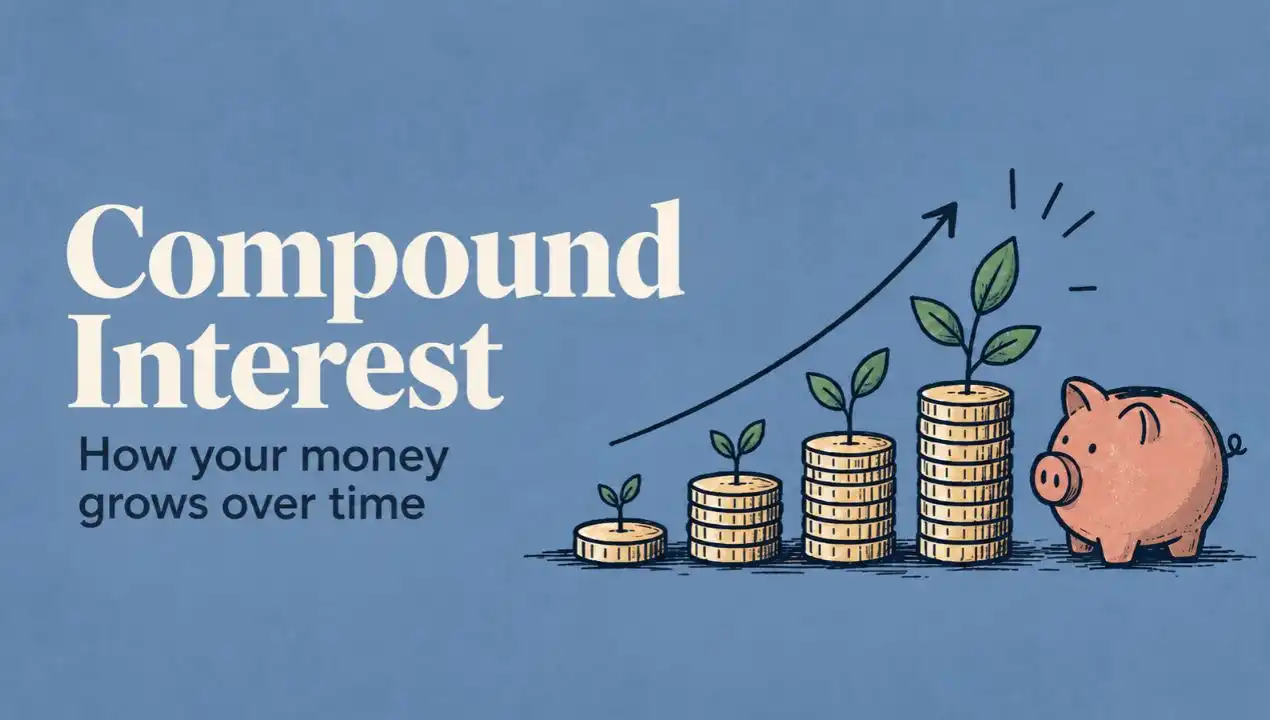
Compound interest means you earn returns not only on the money you originally invested, but also on the returns that money has already generated.
That is why starting young can have such a large effect on long-term wealth.
The advantage is not that younger investors automatically earn higher returns. It is that they have more time for returns to build on previous returns.
Someone investing R1,000 a month for 30 years can end up with far more than three times the amount accumulated by investing R1,000 a month for 10 years, even though the monthly contribution never changes.
Time is doing a large part of the work.
What is compound interest?
Compound interest is growth on both your original investment and the returns already earned.
Suppose you invest R10,000 and earn 10% in the first year.
At the end of the year, you have:
R10,000 + R1,000 = R11,000
If the investment earns another 10% the following year, the return is no longer calculated on only the original R10,000.
It is calculated on R11,000.
That produces:
R11,000 × 10% = R1,100
Your investment then grows to:
R12,100
The extra R100 may look small at first.
Over decades, however, repeated compounding can create a much larger difference.
What is the difference between simple and compound interest?
Simple interest is calculated only on the original amount. Compound interest includes returns earned on previous returns.
Imagine R10,000 earning 10% a year for 10 years.
With simple interest:
- Original investment: R10,000
- Annual interest: R1,000
- Interest over 10 years: R10,000
- Final amount: R20,000
With annual compounding at 10%, the same R10,000 would grow to roughly R25,937 after 10 years.
The difference becomes larger as more time passes.
That is why compounding is especially important for long-term investing.
Does compound interest apply only to bank accounts?
No. The phrase is commonly associated with savings accounts, but the same compounding principle applies more broadly to investing.
With shares, ETFs and unit trusts, you may earn returns through:
- Capital growth
- Dividends
- Interest
- Distributions
If those returns stay invested rather than being spent, they can generate additional future returns.
Technically, investment returns are not always “interest”, so compound growth is often a more accurate description.
The principle is the same: returns remain invested and begin contributing to future growth.
Why does starting young make such a big difference?
Because compounding needs time. The first few years can feel slow.
As the investment becomes larger, the same percentage return starts producing bigger rand amounts.
For example, an 8% return on:
- R10,000 = R800
- R100,000 = R8,000
- R500,000 = R40,000
- R1 million = R80,000
The percentage is unchanged.
What changes is the amount of money already working for you.
A young investor has decades in which contributions and accumulated returns can build that larger base.
What happens if you invest R1,000 a month?
Consider a simplified example where you invest R1,000 every month and earn an average return of 8% a year, compounded monthly.
The approximate values would be:
| Time invested | Your contributions | Approximate investment value |
|---|---|---|
| 10 years | R120,000 | R182,946 |
| 20 years | R240,000 | R589,020 |
| 30 years | R360,000 | R1,490,359 |
The 30-year investor contributed only three times as much as the 10-year investor.
But the final investment is more than eight times as large.
That difference comes from the extra years of compound growth.
These figures are illustrations rather than forecasts. Real investment returns vary, fees and taxes can reduce returns, and markets do not deliver the same percentage every year.
What if you can afford only R500 a month?
Starting with a smaller amount can still be valuable.
At the same hypothetical 8% annual return:
| Time invested | Contributions | Approximate investment value |
|---|---|---|
| 10 years | R60,000 | R91,473 |
| 20 years | R120,000 | R294,510 |
| 30 years | R180,000 | R745,180 |
The person investing R500 a month for 30 years contributes R180,000 but could accumulate roughly R745,000 under those assumptions.
The lesson is not that 8% is guaranteed.
It is that small contributions can become meaningful when they are given enough time.
What if you invest R2,000 a month?
Using the same 8% illustration:
| Time invested | Contributions | Approximate investment value |
|---|---|---|
| 10 years | R240,000 | R365,892 |
| 20 years | R480,000 | R1,178,041 |
| 30 years | R720,000 | R2,980,719 |
Again, the investment is not growing in a straight line.
The later years contribute disproportionately to the final value because the accumulated balance is much larger.
Why does the growth accelerate later?
Compounding can feel disappointing at the beginning because most of the investment still consists of your own contributions.
After enough time, investment returns can begin contributing more heavily.
Suppose your portfolio reaches R1 million.
An 8% year would represent R80,000 of growth before fees, taxes and market fluctuations.
That is equivalent to more than six years of R1,000 monthly contributions.
The larger the portfolio becomes, the more powerful each percentage point of return becomes.
This is why long-term investors often describe the early years as the accumulation stage.
You are building the base that can later compound more noticeably.
Is an 8% return realistic?
It is useful for illustration, but it should never be treated as a promise.
Investments do not produce smooth annual returns.
An equity investment might gain strongly one year and fall sharply the next.
Actual long-term results depend on:
- Asset allocation
- Market performance
- Fees
- Tax
- Inflation
- Currency movements
- Investment discipline
- Time horizon
A projection calculator can help you understand compounding mathematically, but it cannot tell you exactly what markets will deliver.
What happens if returns are lower?
Lower returns still compound, but the final value can be much smaller.
For example, the difference between averaging 6% and 10% over several decades can become enormous.
That is because the return difference itself compounds.
This is why investment fees also matter.
A seemingly small annual cost can reduce the amount left in the portfolio to compound over future years.
Why do fees matter so much over 30 years?
Investment fees are usually quoted as small percentages.
But every rand removed in fees is a rand that can no longer generate future returns.
Suppose two investments produce the same underlying performance, but one costs significantly more each year.
The higher-cost investment loses money in two ways:
- You pay the fee.
- You lose the future growth that the fee amount could have earned.
The longer you invest, the more significant this second effect can become.
This is one reason investors should compare platform charges, fund fees, advice costs and transaction costs rather than focusing only on historical performance.
Does inflation affect compound growth?
Yes. An investment can grow in rand terms while your purchasing power grows much more slowly.
Suppose an investment produces 8% over a period when inflation averages 5%.
Your real return is much lower than 8%.
The purpose of long-term investing is therefore not simply to make the account balance larger.
You generally want your money to grow faster than inflation over time so that it can buy more in the future.
This is one reason keeping all long-term savings in cash can carry its own risk.
Cash may be relatively stable in nominal terms, but inflation gradually reduces what it can buy.
Why is compound growth so important for young investors?
Young investors may not yet have large salaries or large amounts of capital.
What they do have is time.
A 22-year-old does not need to invest hundreds of thousands of rand immediately to benefit from compounding.
Starting with R500 or R1,000 a month can create a base that future salary increases can build on.
A 45-year-old earning much more may be able to invest a larger amount each month, but they have fewer years before retirement.
Money and time can partly compensate for each other, but time is difficult to replace once it has passed.
Is starting early more important than investing more later?
Both matter. Starting early gives compounding more time. Investing more increases the amount being compounded.
The strongest combination is:
start early, then increase contributions as your income grows.
You do not need to choose between them.
Someone might begin with R500 a month as a graduate, increase to R1,500 after a promotion and eventually invest R5,000 or more as their career develops.
That can be much more realistic than waiting until you can afford a large monthly amount.
What happens if you wait 10 years to start?
The cost is not only the contributions you missed.
You also lose the future growth those early contributions could have generated.
Suppose Investor A starts at 25.
Investor B starts at 35.
Even if Investor B later contributes aggressively, Investor A has a ten-year compounding advantage that can be difficult to recover.
That is why delaying investing can be expensive even when your future salary is likely to be higher.
The early contributions have the longest period in which to grow.
Does this mean you should invest before paying debt?
Not automatically. Compound returns work against you when you owe expensive debt.
Credit cards, personal loans and other high-interest borrowing can compound too, but in favour of the lender rather than you.
If you are paying 25% interest on debt while expecting perhaps 8% from investments, aggressively investing instead of reducing the expensive debt can leave you worse off.
A sensible order may involve:
- Paying essential expenses
- Building some emergency savings
- Addressing expensive debt
- Then increasing long-term investing
The exact balance depends on your finances.
Why does debt compound so quickly?
Interest can be charged on an outstanding balance that already includes previous unpaid interest and costs, depending on the credit structure.
That means compounding can work in the opposite direction.
With investments, you want returns generating more returns.
With debt, you generally want to prevent interest from creating more interest.
This is why understanding compound growth is useful even if you have not started investing yet.
It applies to both wealth creation and borrowing.
Should you wait until you have a higher salary?
Usually, starting with an affordable amount is better than postponing investing indefinitely.
A common mistake is saying:
“I’ll start when I earn R30,000.”
Then:
“I’ll start when I earn R50,000.”
Lifestyle costs often rise with income, so the perfect time never arrives.
Starting small builds the habit.
You can increase the contribution later.
The first R500 a month is valuable not only because of the money itself, but because it establishes investing as part of your normal monthly budget.
Is monthly investing better than investing once a year?
Neither method is automatically superior in every circumstance.
If the money is already available, investing earlier gives it more time in the market.
If you earn a salary monthly, recurring monthly investing can be easier and more practical. A debit order also reduces the temptation to wait for the “perfect” market entry point.
For most young investors, consistency is more important than trying to optimise the exact day each contribution enters the market.
What is rand-cost averaging?
Rand-cost averaging means investing a fixed rand amount regularly.
For example, you might invest R1,000 into an ETF every month.
When the price is high, your R1,000 buys fewer units.
When the price falls, it buys more units.
This does not guarantee profit or protect you from falling markets.
Its practical value is that it creates a disciplined investing process without requiring you to predict short-term market movements.
Should you stop investing when markets fall?
For a long-term investor, a market decline does not automatically mean you should stop.
If you continue investing the same amount while prices are lower, you buy more investment units.
That can benefit you if markets later recover.
The important condition is that you are investing in an appropriate diversified asset and have a sufficiently long time horizon.
Continuing to invest in a poor-quality or unsuitable investment simply because it has fallen is not a strategy.
Does reinvesting dividends help compounding?
Yes. If an investment pays dividends and you spend them, those dividends no longer participate in future growth.
If they are reinvested, they buy additional assets that can themselves generate future returns.
For South African investors outside tax-exempt structures, dividends can also have tax consequences. SARS currently states that dividends paid to individuals by South African companies generally attract 20% dividends tax, subject to applicable exemptions or reduced rates.
Inside a qualifying Tax-Free Savings Account, the tax treatment is different.
How does a TFSA improve compounding?
A Tax-Free Savings Account can be particularly effective for long-term compound growth because qualifying investment returns are protected from several taxes.
The SARS Tax-Free Investments rules state that returns inside qualifying TFSAs are not subject to income tax, dividends tax or capital gains tax.
From 1 March 2026, the annual TFSA contribution limit is R46,000, while the lifetime contribution limit remains R500,000.
That tax protection means more of the investment’s returns can stay in the account and continue compounding.
Does the R500,000 TFSA lifetime limit stop compounding?
No. The R500,000 limit applies to contributions, not investment growth.
You could eventually have a TFSA worth considerably more than R500,000 without breaking the limit.
For example:
- Lifetime contributions: R500,000
- Investment value after decades: R1.5 million
The additional R1 million is investment growth and does not count as a new contribution.
That distinction is one reason TFSA space can be valuable for younger investors who have decades available for tax-free growth.
Why are TFSA withdrawals important for compound growth?
Withdrawing interrupts the growth process.
It can also permanently reduce the value of your limited TFSA contribution space.
SARS makes clear in its TFSA contribution rules that withdrawn amounts do not restore your annual or lifetime contribution allowance.
If you repeatedly invest and withdraw from a TFSA, you may use valuable contribution capacity before giving the money enough time to compound.
That is why a TFSA often works better for long-term investments than for everyday emergency spending.
How does tax outside a TFSA affect compounding?
Tax can reduce the amount available to remain invested.
For ordinary investments, tax treatment depends on the type of return and your circumstances.
South African individuals currently have an annual capital gains exclusion of R50,000 for the 2027 tax year, according to the SARS capital gains annual-exclusion table.
For individuals, the current maximum effective capital gains tax rate is 18%, as shown in the SARS 2027 capital gains tax rates.
These rules do not mean every investor automatically pays 18% on every gain. CGT depends on taxable gains, exclusions and the individual’s marginal income-tax rate.
The broader point is that taxes can reduce the amount left to compound, which makes tax-efficient investment structures useful.
Does compound interest work with ETFs?
Yes, if the ETF produces growth and you leave that growth invested.
An ETF can increase in value as its underlying assets rise.
It may also distribute dividends or other income.
If distributions are reinvested, they purchase additional units or otherwise remain part of the investment, depending on the fund structure.
Over a long period, both price growth and reinvested income can contribute to compound returns.
What is an accumulating ETF?
Some investment funds automatically reinvest income rather than paying it out to investors.
That can simplify compounding because the income stays inside the fund.
Other funds distribute income to investors, who can then choose whether to spend or reinvest it.
South African investors should still consider the tax treatment of the underlying investment and account structure rather than assuming that automatic reinvestment makes tax disappear.
Compounding and taxation are separate questions.
Does compound growth work with unit trusts?
Yes. A unit trust can produce capital growth and distributions.
If distributions are reinvested, additional units can be acquired.
Those additional units can then participate in future investment returns.
As with ETFs, the actual outcome depends on:
- Underlying investments
- Market performance
- Fees
- Tax
- Time invested
Compounding does not make a weak investment automatically strong.
It amplifies whatever long-term return the investment actually produces.
Does compound interest work with a savings account?
Yes. If interest is added to the account and left there, future interest can be calculated on the larger balance.
A savings account therefore compounds too.
The issue is the expected return.
Cash typically offers lower long-term growth potential than shares, although it usually has much lower short-term volatility.
For emergency savings or short-term goals, that stability can be useful.
For a 30-year investment horizon, relying only on cash may make it harder to grow purchasing power substantially above inflation.
How often does compounding happen?
It depends on the investment. A bank may compound interest:
- Daily
- Monthly
- Quarterly
- Annually
Market investments do not compound according to such a neat schedule because prices move continuously.
When discussing long-term investment projections, returns are often expressed as an annual average even though the actual path may be irregular.
A portfolio could rise 20% one year, fall 10% the next and then rise again.
Compounding still occurs through the changing portfolio value.
What does “annualised return” mean?
An annualised return converts investment performance into an equivalent yearly rate over a period.
This can make investments easier to compare.
But an annualised return does not mean the investment earned exactly that percentage every year.
For example, a five-year annualised return of 9% could have included both strong gains and substantial losses during individual years.
When planning, avoid treating an annualised historical figure as a guaranteed future rate.
Can you calculate compound growth yourself?
A simplified compound-growth formula is:
Future value = Present value × (1 + return rate)^number of periods
For example, R10,000 growing at 8% a year for 20 years would be:
R10,000 × (1.08)^20
That gives approximately:
R46,610
So the original R10,000 grows by more than R36,000 without additional contributions in this simplified example.
Real investing is more complicated because you may contribute monthly, returns fluctuate, fees apply and taxes may matter.
What is the Rule of 72?
The Rule of 72 is a rough shortcut for estimating how long it takes money to double at a particular annual return.
Divide 72 by the assumed rate of return.
For example:
- 6% return: 72 ÷ 6 ≈ 12 years
- 8% return: 72 ÷ 8 ≈ 9 years
- 10% return: 72 ÷ 10 ≈ 7.2 years
It is an approximation, not a precise investment forecast.
Its value is helping you understand how strongly different rates affect long-term growth.
Why does a 2% difference in return matter?
Over one year, the difference between 6% and 8% may not seem dramatic. Over 30 years, it can become substantial.
This happens because the higher return is not simply adding an extra 2% to the original capital each year.
The additional returns themselves remain invested and generate further returns.
The same principle explains why a 2% annual fee difference can become expensive.
Small percentages become much larger when repeated for decades.
Should you chase the highest possible return?
No. Higher potential returns usually come with higher risk.
An investment promising much higher returns than ordinary markets may involve:
- Significant volatility
- Concentration
- Leverage
- Credit risk
- Fraud
The goal is not to find the largest number you can enter into a compound-interest calculator.
It is to choose an investment strategy with a level of risk you can realistically tolerate and maintain.
A lower return you can stick with for 30 years may be more useful than a highly speculative investment you abandon after one major loss.
What role does diversification play?
Diversification spreads your investment across multiple assets rather than relying on one company, sector or market.
Compounding is most useful when the underlying investment survives long enough to keep growing.
Putting everything into one speculative share creates the possibility that a large permanent loss interrupts the process completely.
Broad ETFs and diversified unit trusts can reduce company-specific risk, although they still carry market risk.
Diversification cannot guarantee positive returns, but it can make the long-term investment process less dependent on one outcome.
What happens if you withdraw every time the market rises?
Repeated withdrawals reduce the capital available for future growth.
The same applies to dividends.
If every return is taken out and spent, you are relying more heavily on your own future contributions to grow the portfolio.
There is nothing inherently wrong with eventually using your investment. That is the purpose of wealth.
But during the accumulation stage, reinvesting returns can accelerate growth substantially.
Should you increase contributions every year?
If your income rises, increasing your monthly contribution can make a major difference.
Suppose you start with R1,000 a month.
After a salary increase, you move to R1,200.
Later, you increase it again.
You then benefit from two forces:
- Compound growth on the existing portfolio
- Larger new contributions
This can be much more powerful than leaving your investment contribution unchanged for 20 years while your salary rises.
What is lifestyle inflation?
Lifestyle inflation happens when expenses rise alongside income. You earn more, but you also upgrade:
- Housing
- Cars
- Clothing
- Entertainment
- Subscriptions
- Travel
There is nothing wrong with improving your lifestyle.
The problem comes when every salary increase is absorbed by spending and nothing is directed toward long-term wealth.
Automatically increasing your investment contribution when your salary rises can help prevent that.
Is starting at 30 too late?
No. The value of starting early does not mean you have missed the opportunity if you did not begin at 18 or 21.
At 30, you may still have several decades available before retirement.
At 40, long-term investing can still be important.
The practical response to starting later is generally not to give up.
It is to:
- Start now
- Increase contributions where affordable
- Control fees
- Use appropriate tax structures
- Avoid unnecessary withdrawals
- Stay invested for as long as the goal allows
The best starting date may have been earlier.
The useful starting date is the one you can act on now.
Can you become wealthy with only compound interest?
Compounding is powerful, but it does not replace income, saving and disciplined investing.
You still need capital to compound.
Building long-term wealth usually involves:
Income → Saving → Investing → Returns → Reinvestment → More growth
If you never save anything, there is nothing to compound.
If you constantly withdraw the portfolio, growth is interrupted.
If you take excessive investment risk and lose the capital permanently, compounding stops.
The mathematics works best when supported by good financial behaviour.
What is the biggest advantage young investors have?
It is not necessarily salary. It is time.
A person beginning at 22 may have more than 40 years before traditional retirement age.
Those decades provide opportunities for:
- Monthly contributions
- Salary increases
- Reinvested dividends
- Market recovery after downturns
- Compound growth
- Tax-efficient investing
You cannot guarantee what markets will return during that period.
But you can control when you start, how consistently you contribute, what fees you pay and whether you give the investment enough time.
What should a young investor do first?
Keep it simple. A practical starting process could be:
- Build enough emergency savings for unexpected expenses.
- Deal with very expensive debt.
- Decide how much you can invest every month.
- Choose a diversified investment suitable for your time horizon.
- Use tax-efficient structures such as a TFSA where appropriate.
- Automate the contribution.
- Reinvest returns where suitable.
- Increase the contribution as your income rises.
- Avoid reacting to every short-term market move.
- Give the investment time.
You do not need to predict the next winning share for compounding to work.
You need an investment capable of producing long-term returns and enough patience for those returns to build on themselves.
Why is starting young so powerful?
Because your earliest contributions have the longest time to grow.
R1,000 invested at 25 can compound for decades.
R1,000 invested at 55 has far less time before retirement.
The later contribution is still valuable, but it cannot buy back the years that have already passed. That is the central lesson of compound growth.
You do not need to start with a large portfolio.
You need to start with an amount you can afford, keep contributing and allow enough time for your money to begin earning meaningful returns on the returns it has already earned.
At first, your contributions do most of the work.
Eventually, if the investment performs well and you stay invested, the portfolio itself can begin doing much more of it.
