
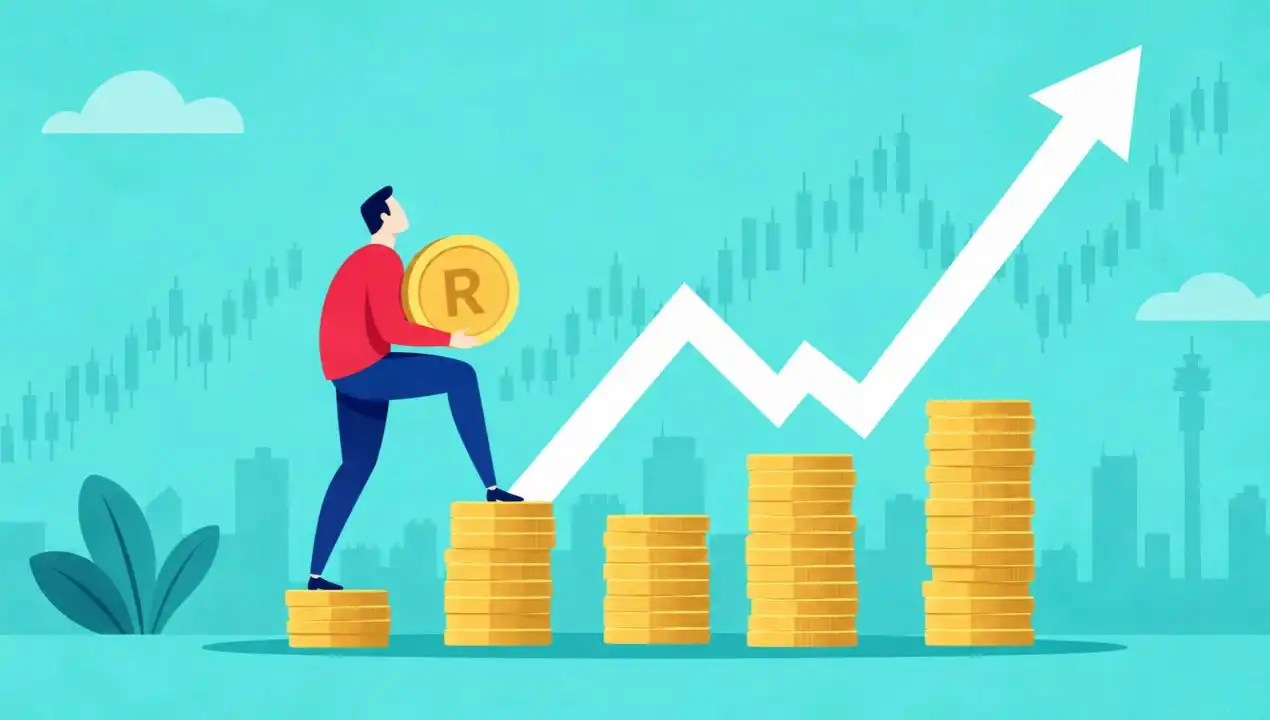
You do not need thousands of rands to start investing in South Africa. You can begin with a small monthly amount, choose a diversified investment such as an ETF or unit trust, and increase your contributions as your income grows.
The more important decision is what you invest in, what it costs and how long you can leave the money invested.
The JSE’s beginner investing guidance directly addresses the idea that you need a large amount of money to begin and explains that lower-cost investment options can make investing accessible with smaller amounts.
For someone starting with R100, R300 or R500 a month, consistency can matter more than waiting until you have a large lump sum.
What should you do before you start investing?
Make sure the money you invest is genuinely long-term money.
If you may need it next month for rent, food or an emergency, it generally should not be exposed to an investment that can fall sharply in value.
Before investing, it makes sense to have your everyday finances reasonably under control. That includes paying essential expenses, dealing with expensive debt and building some emergency savings.
Investing is different from saving.
A savings account is designed mainly to preserve money and keep it accessible. Investments such as shares and equity ETFs can rise and fall significantly.
The JSE’s guidance on whether you are ready to invest makes the same distinction: investments can grow over time, but returns are not guaranteed.
Can you really start investing with R100 or R500?
Yes, depending on the platform and investment you choose.
Many modern investment platforms allow small recurring contributions, and some make fractional investing possible, which means you do not always need enough money to buy a full share.
Traditional investment plans can also accommodate relatively small monthly contributions.
The JSE explains that investors can access ETFs through authorised stockbrokers, ETF providers or online financial-services platforms, including options that support monthly debit orders and lump-sum investments.
The exact minimum differs between providers, so check the current platform rules before opening an account.
What can you invest in with a small amount?
For a beginner, the main choices can include cash investments, unit trusts, exchange-traded funds, individual shares and retirement investments.
The right option depends on what the money is for and how much risk you can accept.
If you are investing for something many years away, such as long-term wealth or retirement, you may be able to accept more short-term volatility than someone who needs the money in two years.
For many beginners, diversified funds are worth understanding before trying to select individual companies.
Why are ETFs popular with beginner investors?
An ETF can give you exposure to many investments through one product.
For example, rather than buying shares in dozens of companies individually, an ETF may track an index containing all of them.
The JSE describes ETFs as listed products that can hold baskets of shares, bonds or commodities and highlights diversification, relatively low costs and accessibility for new investors as key features.
That diversification can make an ETF easier to manage than trying to build a portfolio one company at a time.
It does not make the investment risk-free. If the market tracked by the ETF falls, the value of your investment can fall too.
Should you buy individual shares when starting out?
You can, but you do not need to.
Buying individual shares means deciding which companies you believe will perform well. That requires more research and also concentrates your money.
If you put R500 into one company and that company performs badly, your entire R500 is exposed to that one business.
Put the same money into a broad ETF and you may gain exposure to dozens or hundreds of companies. That is why diversified funds can be a simpler starting point while you learn how markets work.
You can always add individual shares later if they fit your strategy.
What is the difference between an ETF and a unit trust?
Both pool investments together, but an ETF trades on an exchange like a share while a traditional unit trust is generally bought through a fund manager or investment platform.
ETFs are often associated with passive index tracking and low costs, although actively managed ETFs now also exist.
Unit trusts can be actively or passively managed and cover everything from equities to bonds, property, income and multi-asset portfolios.
Neither structure is automatically better.
For someone investing a small monthly amount, fees, diversification and the underlying investments are more important than the label.
Should beginners use a Tax-Free Savings Account?
A Tax-Free Savings Account, more accurately called a tax-free investment, can be extremely useful for long-term investing because qualifying returns are free from income tax, dividends tax and capital gains tax.
The current SARS rules for tax-free investments set the annual contribution limit at R46,000 from 1 March 2026, while the lifetime contribution limit remains R500,000.
That works out to an average of roughly R3,833 per month if you wanted to use the full annual allowance, but you do not need to contribute anywhere near that amount to use a qualifying account.
You could start with R200 or R500 where your chosen provider allows it.
Is a TFSA just a savings account?
Despite the name, a Tax-Free Savings Account does not have to contain cash.
The SARS tax-free investment framework allows qualifying products to be offered by approved financial institutions and investment providers.
This means you can potentially hold ETFs or other qualifying investments inside the tax-free structure.
That distinction is important.
A cash-based TFSA and an equity ETF held inside a TFSA may have completely different long-term return and risk characteristics even though both use the same tax wrapper.
Why should you be careful with the TFSA contribution limit?
The contribution limit applies to the money you put into the account, not its eventual investment value.
For the 2027 tax year, you may contribute up to R46,000 across all your tax-free investment accounts combined.
SARS applies a 40% penalty tax on excess TFSA contributions under the current contribution rules.
Withdrawals also do not restore your contribution room.
If you contribute R20,000, withdraw R10,000 and later put that R10,000 back, the new deposit counts as another contribution.
That is one reason a TFSA is generally better suited to money you intend to leave invested rather than an emergency fund you expect to withdraw regularly.
Should your first investment be local or global?
You do not necessarily need to choose only South African investments.
South African investors can use locally available funds and ETFs that provide exposure to overseas markets.
Global exposure can reduce your dependence on one economy and give you access to businesses and industries that are less represented on the JSE.
A beginner might therefore consider a diversified South African fund, a global fund or a combination of both.
The appropriate mix depends on your goals and risk tolerance rather than a fixed formula.
How important are investment fees?
Very important, particularly when you are starting with small amounts. Fees reduce the money that stays invested and compounds for you.
Depending on the product and platform, costs can include:
- Administration fees
- Management fees
- Brokerage
- Adviser fees
- Transaction charges
If you invest R200 a month but regularly pay relatively large transaction charges, those costs can consume a meaningful part of your contribution.
Compare the percentage and rand cost before opening an account.
A platform that looks cheap for someone investing R10,000 at a time may not necessarily be the cheapest for someone investing R200.
Should you invest every month?
Regular monthly investing can be a practical strategy because you do not need to predict the perfect moment to enter the market.
You simply invest your chosen amount according to a schedule.
For example, you might invest R500 shortly after payday every month rather than waiting until you believe share prices are about to rise.
The JSE’s beginner investing guidance warns against relying on perfect market timing and instead encourages a long-term approach.
Markets will still rise and fall. Regular investing simply removes some of the pressure to make one perfect entry decision.
What happens if the market falls after you invest?
Your investment may temporarily be worth less than you contributed.
That is normal with market-based investments.
Suppose you invest R1,000 into an equity ETF and the market falls 10%. Your investment could be worth roughly R900 before allowing for other factors.
The loss only becomes permanent if the investment never recovers or you sell while its value is depressed.
That is why shares and equity funds are generally more appropriate for long-term goals than money you may need soon.
Short-term market falls are not evidence that investing has stopped working.
How long should you stay invested?
The answer depends on what you own.
Equity investing is usually approached with a long horizon because share prices can fluctuate significantly over shorter periods.
If you are investing for five, ten or twenty years, temporary market falls may be easier to tolerate than if you need the money next year.
Your investment horizon should therefore influence your risk.
Money needed soon should generally be held more conservatively than money intended for retirement decades from now.
What is compound growth?
Compounding happens when the returns generated by an investment begin generating returns of their own.
Suppose you invest R500 and it grows.
If you leave the gains invested, future growth applies not only to the original R500 but also to the returns already accumulated.
Over long periods, this can make the length of time you remain invested extremely important.
Starting with a small amount at 22 can therefore be more powerful than assuming investing only becomes worthwhile once you can afford several thousand rand per month.
Should you wait until you earn more?
Waiting for a higher salary can become an endless delay.
Starting small teaches you how investing works while the financial stakes are still manageable.
You can increase your contribution later.
For example, someone might start at R300 per month, move to R500 after a salary increase and later increase it to R1,000.
The important habit is that your contributions grow with your finances rather than your lifestyle absorbing every increase in income.
What should a beginner invest in first?
There is no investment that is automatically right for every beginner.
A sensible starting point is usually something you understand, that is diversified, affordable and appropriate for your timeframe.
Before investing, you should be able to answer one basic question:
What exactly does this investment own?
If you cannot explain what the fund invests in, why its value could rise or fall and what fees you are paying, spend more time researching before buying.
How do you choose an investment platform?
Look beyond advertising and app design.
Compare:
- Whether the provider is properly authorised
- Investments available
- Minimum contribution
- Platform and administration fees
- Brokerage or transaction costs
- TFSA availability
- Local and offshore choices
- Ease of withdrawing money
- Quality of statements and tax documents
- Customer support
For JSE-listed securities, the JSE explains that investors generally access the market through an authorised stockbroker or appropriate registered investment platform.
Do not send investment money to a provider simply because it has a professional-looking website or active social-media account.
How can you check whether an investment is legitimate?
Investment scams often promise unusually high or guaranteed returns and create pressure to deposit money quickly.
Be particularly cautious when someone approaches you unexpectedly through WhatsApp, Telegram or social media and claims to have a low-risk way to generate extraordinary returns.
The JSE provides tools that can help investors verify authorised stockbrokers before sending money for JSE investments.
If the product is being provided as a financial service, verify the provider’s regulatory status before handing over money.
Do not assume that an app, influencer or online trading group is legitimate because other people appear to be making money.
Is keeping money in a bank account the same as investing?
No.
A bank savings account generally prioritises capital preservation and accessibility.
An investment accepts some degree of risk in pursuit of higher potential returns.
The South African Reserve Bank explains through its CODI deposit-insurance guidance that qualifying bank deposits are protected up to R100,000 per qualifying depositor per bank if a member bank fails.
That protection does not apply to ordinary market losses on shares, ETFs or unit trusts.
If an ETF falls because markets decline, CODI does not reimburse the loss.
Should you invest while you have debt?
It depends on the debt.
If you have expensive debt charging 25% or 30% interest, paying it down may provide a more certain financial benefit than hoping an investment earns more than that rate.
A home loan at a much lower rate presents a different decision. You also do not necessarily need to finish paying every form of debt before investing for retirement.
Compare the cost of your debt, your financial goals and the consequences of delaying long-term saving.
High-cost consumer debt deserves particular attention.
How much should you invest each month?
Invest an amount you can sustain.
R300 invested consistently is more useful than committing to R2,000 and stopping after two months because your budget cannot support it.
You could start with a fixed rand amount or a percentage of your income and increase it when your finances improve.
The exact figure matters less than ensuring that essential expenses and short-term financial stability are covered first.
What could starting with R500 a month look like?
Imagine you decide to invest R500 per month. You could set up an automatic contribution shortly after payday into a diversified investment.
After a year, you would have contributed R6,000.
After five years, you would have contributed R30,000 before investment gains or losses.
If your salary improves and you eventually raise the monthly amount, your contributions can begin growing much faster.
The important point is that the first R500 does not need to make you wealthy.
Its job is to get the investment process started.
What mistakes should new investors avoid?
The biggest mistakes usually come from moving too quickly or investing in something you do not understand.
Avoid:
- Putting emergency money into volatile investments
- Chasing whichever investment has recently performed best
- Borrowing money to speculate
- Concentrating everything in one share
- Paying fees you do not understand
- Buying and selling repeatedly because markets move
- Trusting promises of guaranteed high returns
You also do not need ten investment products simply because you are starting to take investing seriously.
A simple portfolio you understand is usually easier to manage than a complicated collection of overlapping investments.
How do you start investing in South Africa?
A practical approach is to decide what you are investing for, choose a timeframe, decide how much you can contribute consistently and then compare regulated investment providers.
For many beginners, a diversified ETF or unit trust can provide a simpler starting point than trying to identify winning individual shares.
If the goal is genuinely long term, also consider whether an approved tax-free investment fits your plan. The current SARS TFSA rules allow annual contributions of up to R46,000 from the 2027 tax year, but you can start with far less.
Most importantly, do not delay because your starting amount feels too small.
The JSE’s beginner investing guidance specifically identifies the belief that you need a large amount of money to start investing as a myth.
Starting with a manageable amount, learning how your investment works and increasing your contribution over time can be a much stronger approach than waiting indefinitely for the day when you finally feel wealthy enough to invest.

1 Comment
Pingback: How the South African Tax-Free Savings Account Works in 2026